The Ideas MachineThe Ideas MachineThe Ideas MachineThe Ideas Machine
  • Home
  • What We Do
  • Who We Are
  • How We Work
  • Clients
  • Blog
  • Contact Us
  • Home
  • What We Do
  • Who We Are
  • How We Work
  • Clients
  • Blog
  • Contact Us
February 10, 2014

Do marketing people really need to learn to code ?

  • Posted By : admin/
  • 0 comments /
  • Under : Innovation

I was reading about Instagram CEO Kevin Systrom, a marketer by day, self taught code geek by night, now hundreds of millions of dollars the better for those late nights.The responses across the web shout out about how we too can make millons if we just learn this important new language and put in the hours.

Not necessarily so, according to Betabeat’s Nitasha Tiku, who rightly points out that the genius in many of the multi million dollar apps is based on marketing insight, not code.

Tiku also points out that there is a big difference between knowing how to code and coding well, and that coding is a specific, professional skill – not something we can all make millions from night classes doing.

The success of Codeacademy and other ‘Code for Dummies’ operations lies, in her view, and in mine, in their fantastic marketing – not in their dissemination of coding skills. Being conversant with the nuances of code, and understanding how it works is an important thing, but the best products and services will always require great marketing insights to make them fly.

codeacademy-copy


February 5, 2014

I want shoes as well as movies 'On Demand'

  • Posted By : admin/
  • 0 comments /
  • Under : Customer Experience, Innovation, Retail Innovation

Shoes made-to-measure were once the preserve of the rich and famous, or the unfortunate necessity for those with unusual shaped and sized feet. Not any more, mass customisation means we can personalise and procure idiosyncratically like never before. Shoe of Prey your-perfect-shoe-v2

offers a 3-D design process and delivers worldwide in 4 weeks, NIKE ID has already pioneered this in flagship stores and online and even Coke started personalising bottle labels in a bid to become more relevant. With Amazon experimenting with same day , 3 hour delivery and 3 D printing – it’s more than movies we can start to expect on demand. Companies like Chicago based eThreads are set to succeed where Levi’s and others made in roads and failed. The tech is better than it was in the 90’s and the distribution networks are there too. Ready, Set Go!

What does all this ‘on demand’ stuff mean for your business  /brand  /production /delivery / IT /eCRM ?  Customer experience innovation, brand and product managers, IT teams and logistics people can no longer afford to ignore some of these radical changes – even if the picture seems a little sci fi right now. It’s not, it’s more and more real every day.  Plenty has been written about mass customisation, check some of it out here.

Business models have to adapt, marketing has to keep up and customers are in charge…. all this we know , we’re told it so often it’s like wallpaper, but think about it again for a second. How prepared are you – what if your customers could order in the morning and get it by lunchtime, what if they could download the file and print a 3D version at home…. when I can order my own  personalised version of pretty much anything, I won’t want what you’re selling unless I can play around with it, and effectively get it on demand.


February 1, 2014

How Betabrand gets amazing customer engagement

  • Posted By : admin/
  • 0 comments /
  • Under : Case Studies, Customer Experience, Innovation

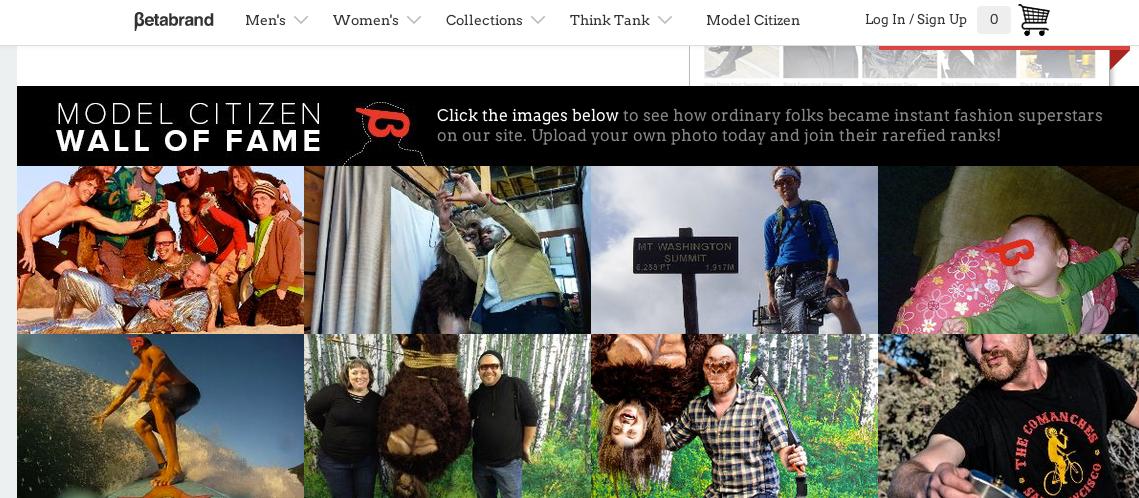
Love this!  US online clothing retailer Betabrand offers instant discounts to customers in return for their pictures  in Betabrand clothes and accessories, simple enough – This example gets it right on every level – lovely tone of voice and personality -collections of great pictures  in their Wall of Fame Model Citizen section- this is the best example of brand fans I have seen in a while. It is also a clear example of how important and ‘sticky’ user generated content can be, and how to make your customers work for you in the online space.

Betabrand have really got the  language right too. I  love their ‘Model Citizen’ concept to house all the pictures!

They ask for weird and whacky and they get it!

22671632-betabrand_modelcitizen

Innovation wise, this is an example of a brand really thinking about how to engage in conversation with it’s fans online. They have spent time understanding how customers can be advocates and are generous enough to allow their fans space to share their own stuff on  site too…they mean it, and that all adds to the love-in.

Calling the section Model Citizen, tongue in cheek and playful and celebrating the Wall of Fame works.

Celebrating those who celebrate you is a top tip when it comes to customer experience innovation.

How good are you at recognising the people who love your brand /product ? How easy is it for them to engage and publicise their enthusiasm  on your site ?  How many clothing brands do you know who’d have  a picture of a kid in a green onesie sporting a pair of their up market sun glasses  ?

Check the images out on Betabrand’s Model Citizen section. See what happens when you relax the brand control uptightness a bit, relinquishing a bit of that ‘control’ can pay back in spades.

Betabrand Customers in their clothing  -

Betabrand Customers in their clothing –


January 27, 2014

Fear of saying something stupid is a barrier to innovation

  • Posted By : admin/
  • 0 comments /
  • Under : Innovation, Uncategorized

albert-einstein-intuition-page2397We love this blog piece, especially the analysis of framing innovation as ‘problem’ vs opportunity – and how people’s fears of ‘saying something stupid’ are a barrier to innovation. Obvious, but very, very true and often overlooked.

Personal take-aways from: Chapter 4: Of Innovation, Intuition and Imposters: Intangible Vulnerabilities in the Brains of Great Leaders (Pages 91-101)

Making “problems” part of innovation appears to be a substantial mindset change to discover new solutions. Knowing that a problem is something “normal” will relax people to take their time to find the similarities across great semantic differences. The saying “just give it time” makes even more sense now. This goes hand in hand with other topics discussed in other parts of the book; a focus change away from the perception that a problem is something negative towards something positive: that a problem is one way of innovation calling to be discovered. 

It also seems to be important to have created a context for innovation in terms of the company culture. Although the book doesn’t specifically state it that way, but the fact that there may be tensions between madness and creativity, might explain the following thought process: “I don’t want to sound like a fool in front of my employees/the others.” Leaders might fall short of their own creative potential because they are afraid to say something “stupid” because they think that if the people they work with don’t understand it, they will have lose the leadership status they have had in the past. The same might be the reason why sometimes innovation is so hard to come by: because people are afraid to say something “stupid” that cannot be understood by the mindsets and paradigms of the people they work with. Changing this context by creating an “idea-free zone” might help people and leaders to truly open up without feeling the pressure of having to sound “intelligent” or to be understood. To challenge the status-quo might call for “stupid ideas.” Let´s think about the great inventors such as Bell, Tesla, the Wright Brothers and Babbage. 

View original


January 26, 2014

How to Innovate with Pubic Hair: American Apparel

  • Posted By : admin/
  • 0 comments /
  • Under : Customer Experience, Innovation, Uncategorized

It would be churlish not to comment on US clothing retailer American Apparel ‘s decision to ‘shock’ using mannequins with full pubic hair. Seen here sporting a rather large ‘bush’ showing through flimsy undergarments, this plastic lady and her plastic friends have been seen across select AA US store window displays.

Personally, I love it.  Interesting that something so, shall we say, ubiquitous can be used to such great PR effect. Simple, cheap to do, massive PR, what’s not to like ?

From an innovation perspective, this example teaches there is value in revisiting taboos. It encourages us not to feel like we have to beat the marketing teams of our competitors by playing according to category or advertising rules and mores.

I am not saying massive ‘bush in-ya-face’ is the best tactic for a fashion brand, nor that shock tactics are always a great plan, but this American Apparel stunt certainly got buzz  and  let’s face it, the story adds a degree of interest to what is otherwise a black and white box selling sweat tops and casual gear.

imgres


January 26, 2014

Why celebrating failure is important for innovation

  • Posted By : admin/
  • 0 comments /
  • Under : Case Studies, Innovation

So the blogosphere is all over GoogleX, the skunkworks ‘hub’ where only the most intractable and real problems make the cut for an ambitions group of moon-seekers – and a place where they celebrate and relish failure.

The idea that failure is good for innovation is of course nothing new; we have been banging on about celebrating failure for years. Those of us who know what it feels like to have messed up big time, or seen a dream project slip sulkily down the drain of lost hope know it is easier said than done. It is only a properly innovative, grown up company ( note: not necessarily a large one) that actually manages to deal with this stuff, never mind celebrating it. I applaude Google for making their failures as much a story as their new ( and utterly incredible) intelligent contact lenses!

Fast Company way back in 2005, cited some excellent examples of failure and its importance to innovation: from Brit James Dyson, to Italian design icon Alberto Alessi , I love their list of those who manage and flourish in the face of failure.

I particularly rate the quote from legendary sculptor Henry Moore  who said: ‘The secret of life is to have a task, something you bring everything to, every minute of the day for your whole life. And the most important thing is: It must be something you cannot possibly do.’ Now there’s a challenge to innovate if ever I saw one!

CC www.theguardian.com

CC www.theguardian.com


January 24, 2014

What Eric Schmidt says about Innovation- Davos 2014

  • Posted By : admin/
  • 0 comments /
  • Under : Innovation

Innovation and adapting to new technology heralds the end of the 9-5 job according to Google’s Eric Schmidt speaking at Davos this week. He notes this as a real challenge for advanced economies looking to create jobs. Interesting stuff. Is innovation by SMEs and Entrepreneurs enough ? Read more from Eric at Davos 2014 here.

:_72486315_72486312


December 10, 2013

Amazing logistics lessons from Mumbai Dabawallahs

  • Posted By : admin/
  • 0 comments /
  • Under : Case Studies, Customer Experience, Innovation, Retail Innovation

An incredible logistics story from Mumbai’s legendary Dabawallahs. In his TED talk Dr Pawan Agrawal explains how this Indian group rivals the likes of DHL …..many hail from the same village and they deliver hundreds and thousands of tiffin boxes daily to Mumbai workers. Dr Agrawal reveals the secrets that won  this awesome team accolades from Forbes. Their Dabawallah Code and the secret of their success is based on centuries old traditions. They recruit on enthusiasm and their delivery output and efficiency is something many Blue Chips only dream of.

From an innovation perspective, looking at related worlds, other cultures and sectors can often yield fruitful stimulus to apply to your own.

Tiffin and tea anyone ?

images-1


November 20, 2013

What is a database of millions of human feelings ?

  • Posted By : admin/
  • 0 comments /
  • Under : Innovation

We Feel Fine is a wonderful project scraping millions of human feelings from the web, curated in what started as an art project and has blossomed into a book, TED talks, APIs and an inspirational journey. I love this innovative take on the implications of new technology and the lens it provides on some of life’s fundamentals. This is innovation meets internet art.

I love the audacity of their mission and the output is intriguing and creative. Emotions are ‘curated’ into 6 ‘Movements’ – madness, murmurs, montage, mobs, metrics and mounds – not a bad taxonomy.

As they say, the We Feel Fine project is emergent and it changes as we all change, ‘an artwork authored by everyone’ . Big up to founders Jonathan Harris and Sep Kanvar.

Check them out at We Feel Fine 

wff


August 24, 2013

The Amazings – a wonderful example of innovation for the ageing population

  • Posted By : admin/
  • 0 comments /
  • Under : Case Studies, Innovation


I love these people and their idea. Let’s face it, most of the stuff out there makes getting old sound pretty rough. The team at ‘The Amazings’ is changing all that. Based on a simple notion that we can learn from our elders, executed in an upbeat, friendly, collaborative way – it’ll have you wanting to learn Tango in no time. They have a section on their website outlining their story, I applaud their candour and wish them every success. Really interesting to note the step changes in their journey and what happened when they brought the idea to life using videos of their Amazings – the elders who have a lot to teach us all.  This is exactly what UK innovation hub NESTA should be funding too. Well done guys! Check out their story and follow @TheAmazings

The Amazings


July 31, 2013

Innovate or else…

  • Posted By : admin/
  • 0 comments /
  • Under : Brands, Innovation

Great piece from Business Week on what happens to brands which fail to innovate. Simply put, if the world keeps moving on and your brand stands still, don’t be surprised when it all goes horribly wrong. The article cites great examples of brands putting innovation at the heart of what they do vs. those who pay the price of complacency.  It’s the reason the once popular Twinkies are no longer a lunch box staple.

Hostess-Twinkies-box


Related articles
  • The Importance of Keeping Your Brand Fresh (displaybay.com.au)
  • Innovate or die? (iowabiz.com)
  • Companies must innovate or die — here’s how IT can help (bizsugar.com)

July 24, 2013

A Nation of Storytellers

  • Posted By : admin/
  • 0 comments /
  • Under : Innovation
The Ministry of Stories

The Ministry of Stories

An amazing place in East London, The Ministry of Stories.

Located in a shop selling intriguing Monster Supplies to the Harry Potter Generation, supported by some big name writers, these guys run storytelling workshops to inspire a new community of young writers. And it’s free! Genius.


1234
Recent Posts
  • Mckinsey Creates Design Thinkers Index
  • What Imogen Heap has to teach us about Innovation
  • Will a robot take your job ?
Recent Comments
    Archives
    • October 2018
    • October 2017
    • September 2017
    • June 2015
    • January 2015
    • December 2014
    • November 2014
    • October 2014
    • September 2014
    • August 2014
    • July 2014
    • June 2014
    • May 2014
    • April 2014
    • March 2014
    • February 2014
    • January 2014
    • December 2013
    • November 2013
    • August 2013
    • July 2013
    • June 2013
    Contact Us
    • Email
      team@sociolus.com
    2018 © The Ideas Machine. All rights reserved. For our privacy policy and how we use your data click here